Albinism: Another excuse to collect the rare and exotic?

Across the entire animal kingdom there are some fascinating, sometimes even unbelievable characteristics. The adaptations that have made it through natural selection, been accepted by females and after all that aren’t a disadvantage, are truly exquisite. How do these adaptations come about? Random genetic mutations are at the beginning of every single adaptation on this planet. It is these mutations within the gene that are responsible for colouration, size, shape and many more! Sometimes mutations can result in something which is not advantageous – a mutational disorder. The disorder I wanted to discuss today is albinism.

Albinism is a disorder characterised by the absence of pigment in the skin, hair and eyes. It is caused by a mutation in the gene that is responsible for the enzyme that makes melanin. This gene is known to affect all vertebrates, including humans. There are numerous associated secondary effects of albinism such as vision defects and a greater susceptibility for sunburn and skin cancers. Furthermore there are social stigmas in human society leading to albinos being ridiculed, bullied and in some parts of the world, being killed to use their body parts in potions.
Non-human animals that are albino tend to have very low survival rates in the wild. Because they are albino, they lose their protective camouflage and sometimes struggle to reproduce as they are perceived as different to the rest of the population.

Recently scientists in Russia have spotted an albino killer whale off the coast of eastern Russia. The killer whale, affectionately named Iceberg, is thought to be the first albino killer whale seen in the wild. The scientists are aiming to find out if Iceberg is fully albino by trying to photograph his eyes. If they are pink he is fully albino. This is important information because fully albino killer whales are known to have problems with their immune system. The video below shows the whale the scientists spotted!


The fascinating individuals that have albinism do not stop with Iceberg. Snowflake was an albino Western Lowland Gorilla who resided at Barcelona Zoo. As I’m sure you can imagine albino animals are very desirable and therefore can fetch a high price. When Snowflake was discovered in the wild in 1966 his entire social group was killed, including his mother who he was found clinging on to after the massacre. Snowflake lived out a long life at the zoo and was even the unofficial mascot of the city, but there is a certain element of sadness that he was taken away from his mother just because he looked different.

Finally, there is the exceptionally cute albino pygmy hedgehog. This group of albinos is a subset of the domesticated hedgehog. They have been popular since the early 1980s and are bred by many RSPCA centres. The internet is littered with a considerable number of adverts to buy these animals for around £120. There are many restrictions to owning these animals because of their ability to spread diseases such as Foot and Mouth. Again, would these animals be so popular if they were not so different? Hedgehogs travel many miles each night and usually hibernate in the winter. Do they do that in their cages?

While these animals are fascinating to see, Snowflake’s case is not an isolated incident. Humans have always been driven to collect the rare and exotic, whether it is in a zoo or to keep at home. On one hand, these animals do have a shorter life expectancy in the wild, but on the other hand is it right to capture these animals or to breed them? The reality of the matter is these animals wouldn’t be so popular if they were not so different. There also wouldn’t be awful situations such as Snowflake’s if people understood the hardship these animals have had to go through to for public amusement. It is one thing to capture species under threat and bring them to the wild, it is another to capture an animal and tear it away from its family and home because it looks different and humans will pay to see it.

Print Friendly

Posted in Uncategorized | Leave a comment

Ready or not, here European malaria comes … are we ready?

The questionnaire linked below is now closed. Thank you for your participation, I truely appreciate it.

To those of you who are not familiar to my blog, my name is Victoria Ellis and I am in my final year at the University of Manchester studying Zoology. As part of my final year project I am required to write a post on my blog and access how useful the post was to my readers. To do this I have created a very small questionnaire (7 questions), that simply requires you to answer questions on various aspects of malaria before and after reading this post. This is not a test of your knowledge, but a test of how your knowledge has changed as a result of reading my blog post. I would really appreciate it if you took the time to do this; it will only take a couple of minutes and is completely anonymous.

Instructions: There are 3 questions to answer before reading the blog post and another 4 to answer after reading the blog post.

Please click the following link to commence: Start the questionnaire!

Thank you in advance for your time.

Ready or not, here European malaria comes … are we ready?
Have you ever gone on holiday and had to take antimalarial tablets? Did you accidently forget to take one and panic about getting malaria? What if malaria came to the UK? How would you like having to take antimalarial tablets every day for the rest of your life? That possibility is a lot more likely than you might imagine.

Global warming is causing temperatures in the northern hemisphere to increase and soon those temperatures will be at a sufficient level to support malaria, particularly in the south of Europe (Becker, 2009). As the threat of malaria risk increases, both the public and policy makers in Europe look to scientists for ways of preventing the disease from spreading, and killing the millions of people it currently does in the tropics.

Conventional malaria control
There are two main areas of anti-malaria research; conventional methods and genetic modification. Conventional methods of malaria control include insecticide treated bednets (ITNs) and antimalarial drugs. ITNs are proven to be highly effective in reducing malaria-related morbidity, particularly in children under the age of 5. However a survey in Ethiopia found that only 65% of people with ITNs actually used them. Many mothers use the nets as scarves or bed sheets instead of using them for protection against malaria. Of those that do use the nets, insecticide is rarely reapplied and so the nets quickly become less effective (Deribew et al., 2012).

Another conventional way of controlling malaria is the use of antimalarial drugs. There are several different types of antimalarial drugs affecting different stages of the Plasmodium ( the parasite that causes malaria,) life cycle. A good antimalarial drug will kill Plasmodium early in the life cycle, while it is still in the blood of the human host. This prevents many of the more severe symptoms of malaria infection developing. A good antimalarial drug should also remain active against drug-resistant strains of Plasmodium. There are several problems with antimalarial drugs, particularly due to accessibility in developing countries. This includes the distance to healthcare, financial funds available to those who need the medication and the lack of knowledge about antimalarial drugs. Furthermore there are also issues of drug resistance, meaning that drugs must be continually developed to avoid Plasmodium resistance (Bogitsh and Cheng, 1990).

Genetic modification as a means for malaria control
In the new age of modern technology other methods of malaria control are quickly becoming plausible. This is particularly the case in the field of genetic modification. One potential method of malaria control is through the use of paratransgenesis. This involves the genetic modification of bacteria living within mosquitos to be “anti-Plasmodium”. These bacteria are then reintroduced into wild mosquito populations, with the hope the “anti-Plasmodium” bacteria will spread through the population, blocking the transmission of Plasmodium into humans. However, the bacteria found in wild mosquitos are not well defined and as a result this method is still in its primitive stage (Chavshin et al., 2012, Sadanand, 2010).

A method that is available for use now is the genetic modification of mosquitos themselves. This involves identifying which genes are responsible for the secretion of proteins in areas that come into contact with the parasite – the midgut lumen, hemocoel and salivary gland. If a gene is manipulated that changes protein expression, then that protein could have severe knock-on effects for the parasite, and perhaps even prevent Plasmodium from being able to live within the mosquito. This would completely break down the parasite life cycle. However, by genetically modifying mosquitos, they may be at a disadvantage compared to wild mosquitos. If this is the case the genetically modified mosquitos would be out competed by the wild mosquitos, wasting the time and money spent on the project (Riehle et al., 2003).

Conclusion
In the area of conventional malaria control, the main problematic factor seems to be the issue of accessibility. In the case of genetic modification, there is an issue of the amount of time that will be needed before the mosquitos are ready to be released into areas suffering from malaria. As a result, effective malaria control requires two actions to take place. The most effective way of controlling malaria is likely to be through genetic modification. Until this method is ready for use, a considerable effort should be made in ensuring conventional methods of malaria control are more effective. If these methods are more effective they will control the problem until genetically modified mosquitos are available. Other areas to consider include researching how the genetically modified mosquitos will be released into the wild and how they will interact with wild mosquitos. With the upcoming addition of genetic modification to our tools to fight malaria, we can remain optimistic that should malaria enter Europe, we will have the arsenal to tackle it.

References
BECKER, N. 2009. The impact of globalization and climate change on the development of mosquitoes and mosquito-borne diseases in Central Europe. Environment science and pollution research, 21, 212-222.
BOGITSH, B. & CHENG, T. 1990. Human Parasitology, USA, Saunders College Publishing.
CHAVSHIN, A. R., OSHAGHI, M. A., VATANDOOST, H., POURMAND, M. R., RAEISI, A., ENAYATI, A. A., MARDANI, N. & GHOORCHIAN, S. 2012. Identification of bacterial microflora in the midgut of the larvae and adult of wild caught Anopheles stephensi: A step toward finding suitable paratransgenesis candidates. Acta Tropica, 121, 129-134.
DERIBEW, A., BIRHANU, Z., SENA, L., DEJENE, T., REDA, A. A., SUDHAKAR, M., ALEMSEGED, F., TESSEMA, F., ZEYNUDIN, A., BIADGILIGN, S. & DERIBE, K. 2012. The effect of household heads training about the use of treated bed nets on the burden of malaria and anaemia in under-five children: a cluster randomized trial in Ethiopia. Malaria Journal, 11, 8.
RIEHLE, M. A., SRINIVASAN, P., MOREIRA, C. K. & JACOBS-LORENA, M. 2003. Towards genetic manipulation of wild mosquito populations to combat malaria: advances and challenges. Journal of Experimental Biology, 206, 3809-3816.
SADANAND, S. 2010. Malaria: An evaluation of the current state of research on pathogenesis and antimalarial drugs. Yale Journal of Biology and Medicine, 83, 185-191.

Print Friendly

Posted in Uncategorized | 1 Comment

Ethical considerations of sustainable fishing in Europe

The United Nations (UN) estimate that 200 million people are directly or indirectly employed by the fishing industry and around 1 billion people depend on fish as their primary source of protein. The UN also reports that one quarter of the world’s fish stocks are over exploited and half the world’s fish stocks are fully exploited (UN, 2010). To try and counter this problem the concept of sustainable fishing has been proposed. Sustainable fishing is a “combination of biological, economic and social constraints which need to be met for a viable fishery to exist” (Martinet et al., 2007). Sustainable fishing aims to preserve fish species whilst allowing fishers to use the resource and consumers to buy fish from the fishers. In Europe strict quotas prevent fishers from taking more than their allocated amount of fish. However, as the world population continues to grow there is a pressure on every division of agriculture, including the fishing industry to provide sources of protein. Furthermore, as quotas are reduced there is mounting pressure on fishers to source alternative sources of income for their families. Here I will consider the points of view of both consumers and the fishers themselves. This will lead to an overall appreciation of the factors that affect sustainable fishing.

Consumers
The UK dietary recommendations advise the consumption of at least two portions of fish a week (Clonan et al., 2012). This is the case because of the beneficial proteins, minerals, vitamins and fatty acids found in fish. Eating fish has also been linked to a decreased risk in developing health conditions such as cancer and cardiovascular disease. But, if every person in the UK were to meet these dietary requirements demand for fish would greatly increase while supply (fish stocks and quotas) would decrease, leading to an almost certain increase in the cost of fish. Why should consumers have to pay more for healthier products? In the current economic climate how can consumers be expected to pay more for healthy food, and more again for that food to be sustainable? Furthermore should consumers be deprived of healthy products simply because they can’t afford them? It seems unfair to deprive an individual of healthy food, simply because unhealthy food is cheaper and more accessible (Jacoby, 2004).

As well as depriving a consumer of the choice to eat healthy food, it is also unfair to deprive a customer of sustainable food, if that is what they desire. This is the consumers right to make an informed choice about the quality and sustainability of the food they eat. To ensure this choice is easy to make, public awareness campaigns have been used, as well as promotions in the certification of sustainable fish and ecolabeling of products on the market. This has led to success stories such as dolphin-friendly tuna, which is now widely available and clearly labelled in supermarkets and Marine Stewardship Council (MSC) certified fish in McDonald’s stores (MSC., 2011). However, there are still many popular species of fish being sold to the consumer that are not clearly labelled (Jacquet and Pauly, 2007, Cooke et al., 2011). In this case, the consumer does not know how sustainable the fish they are buying is. Consumers should have a right to make an informed decision and discriminate between products that are and are not harmful to the environment, but they are unable to do so because so few products carry ecolabels.

Fishers
The fishing profession is often kept within families and the trade is passed on from one generation to the next. Throughout these generations fishers have been able to catch what they want. Now strict species-specific fishing quotas have been enforced by many European governments to try and reduce over-fishing. This can be seen as the removal of a fisher’s right to choose what species of fish they catch. Their relatives have been catching whichever species they want for generations, why should they behave differently; they are only supplying consumer demand.
In a recent survey more than half the fishers polled were in favour of these quotas in theory, but many were concerned with the implications they would have for their livelihood. The quotas limit the quantity of fish any vessel can catch and any excess fish caught must be returned to the oceans. If quotas are exceeded then severe fines and other penalties are enforced. Many fishers are concerned that quotas are either too small currently, or will be too small in the future to earn enough money to support their families. Is it ethical to enforce this restriction onto someone’s livelihood? The fishers themselves are not at fault, but if they are unable to live off the money they earn because of these quotas, they may be forced to either exceed quotas while trying not to be caught or look for an alternative income, perhaps even a different profession. Is this a case of depriving someone’s right to provide for their family? Arguably it is. Is the cost to farmers greater than the benefit to the fish in question? Again this depends on where priorities lie between the sufferings of your own species against that of another species. The fishers could get another job, in another industry, but why should they have to? As discussed previously, all they are doing is supplying demand and providing an income to support their families. Should they be punished for that? Should they be punished for that over the well-being of a fish (Hatcher et al., 2002).

As well as a fisher’s right to choice and their well-being, the fairness in which fishers are treated must also be dealt with. Firstly, what fair trade laws and practices are in place, ensuring everyone abides by the quotas? There are regular inspections, as well as fines in place to ensure that all fishers follow the quotas. In February 2012 17 fishermen and a former fish processing factory were fined £960,000 for not following their fishing quotas. In total, almost £3,000,000 was seized as part of a confiscation order against the 17 fishermen. Clearly these fishers thought that the risk was worth the benefits. In actual fact, they were fined less than a third of the value of fish they took from the oceans. Is this an adequate penalty for not abiding to the quotas? These quotas will not work without the support and commitment of all fishers involved. If a minority of individuals do not comply then it is not fair to the majority of fishers who follow the laws in place. However, if quotas are so low that fishers are unable to live off their income, is it worth the risk? Will more fishers be dishonest about the amount of fish they catch? If this were to happen the management plan would be pointless. Is it worth driving fishers to such levels of desperation over fish? This situation should be avoided at all costs but the reality is that fish stocks and therefore quotas will probably decline before they increase, and as such this criminality may become more common (BBC., 2012).

Finally, European fishing quotas have resulted in a decrease in supply, this means there will be an increase in demand and as a result price will increase too. The two likely scenarios from this situation are either a decrease in the amount of fish eaten in Europe, or an increase in fish imported from countries outside of Europe where fish stocks are higher and/or not controlled by quotas. In 1992 a GATT (General Agreement on Trades and Tariffs) dispute panel looked into the United States as they tried to place an embargo on importing tuna from Mexico. The United States argued that the tuna had not been caught using the dolphin friendly procedures enforced on United States fishing fleets and therefore should not be sold in the United States. The panel ruled in favour of Mexico. If this situation were to happen in Europe even more trade would be lost as demand for cheaper fish from other countries increased. This would put fishers under even greater pressure to find the funds to support their family. Does the government then have an obligation to stop the importation of fish from unsustainable sources to protect fishers? If the government does intervene and prevent importing popular species of fish from other countries then they will be depriving consumers of a healthy source of protein. If they do not intervene then the fishers’ income will severely decline, which could lead to exceeding quotas to supplement income. Furthermore, the government could be in a situation like the United States whereby they tried to intervene but their embargo was overturned by GATT. In this case the government would be powerless to prevent the importation of fish into the UK (Beckerman, 2003).

Conclusions
This essay has argued the point that in whichever way fish stocks are managed there will be inevitable human suffering to some degree. To argue this point, first the point of view of the consumer was taken. The aspects discussed included health, eco-labelling and the right to an informed choice. The view point of the fishers was then discussed and included an appreciation for fishers’ freedom to choose as well as the possibility of criminality and possible future scenarios.

A point which has repeatedly surfaced throughout this discussion is the issue of priorities. Essentially this issue breaks down to, who is more important human survival or fish survival. If human survival is most important then the fish stocks will inevitably seize to exist either in the near or distant future. Eventually the demand for fish protein will far exceed any sustainable management plan, and as human survival is more important than fish survival, the fish would have to give way. If fish survival or well-being is most important then there are serious implications for humans. Whether it be consumers or fishers there will be serious suffering felt as a result. Consumers will have to pay more to eat healthier, sustainable food and fishers could have to break the law or find alternative jobs to gain a reasonable income. However, the current opinion is neither a priority to humans or to fish. I believe this is a much more dangerous position to be in than choosing to prioritise fish or humans. By trying to conserve both fish and humans, the consequences if the management strategy fails could be severe for both parties concerned. It strikes me there are going to be difficult questions about our priorities asked in the future, particularly concerning the feasibility of sustainable fishing in Europe. However, I believe these questions will be left unanswered up until a point whereby either consumer or fisher suffering become so great, something has to give, unfortunately that will have to be the fish.

References
BBC. 2012. Skippers and firm fined almost £1m for part in £63m ‘black fish’ scam [Online]. Available: http://www.bbc.co.uk/news/uk-scotland-north-east-orkney-shetland-17153085 [Accessed 22/03/2012.
BECKERMAN, W. 2003. A poverty of reason: sustainable development and economic growth, Oakland, The Independent Institute.
CLONAN, A., HOLDSWORTH, M., SWIFT, J. A., LEIBOVICI, D. & WILSON, P. 2012. The dilemma of healthy eating and environmental sustainability: the case of fish. Public Health Nutrition, 15, 277-284.
COOKE, S. J., MURCHIE, K. J. & DANYLCHUK, A. J. 2011. Sustainable "seafood" ecolabeling and awareness initiatives in the context of inland fisheries: Increasing food security and protecting ecosystems. Bioscience, 61, 911-918.
HATCHER, A., PASCOE, S., BANKS, R. & ARNASON, R. 2002. Future options for UK fish quota management. University of Portsmouth.
JACOBY, E. 2004. The obesity epidemic in the Americas: making healthy choices the easiest choices. Rev Panam Salud Publica, 15, 278-284.
JACQUET, J. L. & PAULY, D. 2007. The rise of seafood awareness campaigns in an era of collapsing fisheries. Marine Policy, 31, 308-313.
MARTINET, V., THEBAUD, O. & DOYEN, L. 2007. Defining viable recovery paths toward sustainable fisheries. Ecological Economics, 64, 411-422.
MSC. 2011. Partner release: McDonald's to bring sustainable fish to millions in Europe. [Online]. Available: http://www.msc.org/newsroom/news/partner-release-mcdonald2019s-to-bring-sustainable-fish-to-millions-in-europe [Accessed 23/03/2012.
UN 2010. The state of world fisheries and aquaculture. FAO Fisheries and Aquaculture Department, Rome.

Print Friendly

Posted in Uncategorized | 1 Comment

Animal tool use shows us humans aren’t so special!

Humans have always been fascinated with what makes us unique. What is it that has allowed us to make such an impression on the Earth like no species before us? There are many things that make humans unique from our ancestors, from bigger brains to bipedalism. We are also known as the “tool using animal”. That is not to say other animals don’t use tools, but humans use tools in an incredible number of activities and to an incredible degree of complexity. Because we arguably use tools better than any other animals, humans often associate tool use with intelligence. There are a variety of animals that use tools, some of which are discussed below.

The most recent addition to the select group of tool using animals is the North American brown bear. The bear was photographed in the Glacier Bay National Park, Alaska in July last year using a rock to rub against its face. The bear was seen sorting through rocks, presumably to find one with the desired qualities. The bear then rubbed the rock on its face and muzzle for around 2 minutes. While it can’t be known for sure, we can assume fairly safely that the bear was using the rock (with barnacles attached) to relieve itchy skin. Bears are commonly seen rubbing against trees or using their claws to scratch, but this is the first recorded case of a bear using an object that can be freely manipulated. These behaviours often go missed because they happen so rarely between only a few individuals.

Elephants are well known for their intelligence and so it is not surprising that these animals use tools. They are incredibly good at problem solving and I myself have seen them use rocks to stand on and reach food otherwise unattainable. In terms of tool use, they are most famous for their use of palm leaves (or similar) to swat away flies. They also use sticks to reach skin irritations. However, there is variability between Elephants and their ability to solve problems. For example, when I worked with Elephants last summer we gave them a coconut each. One tried to bite the coconut open – and failed. Another tried to break the coconut open against a rock – and failed. The final Elephant stood on the coconut – and succeeded. This shows that there is considerable variability between individuals, perhaps due to personality and/or past experiences.

Finally, primates must be acknowledged for their use of tools. Chimpanzees have been observed using sharpened sticks as spears when hunting. They are also well known for using sticks to “fish” for termites and ants from their nests. Gorillas have been observed using sticks to measure the depth of water before they go into it, and have even been seen using a stick to support them as they move through the water. Orangutans have also been seen using sticks to measure water depth, as well as using sticks to break into fruit that has a stinging skin.

Mammals are not the only animals to use tools; many non-mammal animals do as well, including some birds, fish and cephalopods. The huge varieties of problems that are solved using tools, as well as the variety of tools themselves begin to show the cognitive ability required for these activities to evolve. This makes us re-evaluate the cognitive abilities of animals we may not otherwise perceive as “intelligent”. But the re-evaluation only raises more questions, such as how does a new found intelligence change the rights of the animal? If they are capable of complex thought processes then what else are they capable of? At what point does intelligence become so great that we have to redefine animal rights for individuals that show a higher intelligence?

Print Friendly

Posted in Uncategorized | 2 Comments

Orangutan “who do you think you are” sheds light on conservation prospects

The orangutan is an animal very close to my heart. I was lucky enough to work with some of these beautiful and engaging animals during a trip to Borneo a few years ago. There are only two species of orangutan left on the entire planet, both of which are endangered! One species is found on the island of Borneo and the other species on the island of Sumatra. The orangutan is an arboreal animal that lives in dense tropical rainforest. The recent destruction of its habitat for timber extraction and oil palm plantations has resulted in a considerable global effort to conserve the species, before it is too late. However, modern conservation projects are not just a simple case of instigating a rehabilitation, relocation or reproduction programme. In-situ conservation requires an incredible amount of preliminary investigation and management once the programme begins. In particular orangutan population size and densities are not well known. Furthermore, the sample size used in many studies is often too small and does not give an accurate representation of the true orangutan population.

http://img.timeinc.net/time/daily/2009/0907/orangutan_0727.jpg

http://img.timeinc.net/time/daily/2009/0907/orangutan_0727.jpg

The most commonly used method of accessing population size is to take a nest census along a number of line transects. This method is slow and is limited to areas accessible by foot. A new method used for the first time in 2005, uses helicopters to take aerial surveys of population size. The use of a helicopter increases the size of the sampling area and can be completed much quicker than studies carried out by foot. As well as accessing population size, the genetics of the population must be considered. Genetic information is acquired from hair traps and faeces. Obtaining DNA in this way is non-invasive and the animal is completely undisturbed. This is good for an animal that when fully grown, can rip a human in half!

An area of Borneo that has been heavily researched by orangutan conservationists is Sabah, located in the north east of the island. Sabah is estimated to contain 11,000 orangutans at present (, a 35% decline in the population size 20 years ago). 6,600 individuals from the modern day Sabah population live in unprotected commercial forest reserves, subject to extensive timber extraction. There has been a considerable influx of individuals into these commercial areas, when their original habitats were converted to oil palm plantations.
Genetics studies have shown that the genetic diversity within the Sabah population is high. The genetics also showed that prior to the forest fragmentation, males frequently moved up and down the side of the river. By doing so they mated with different females and increased the gene flow between sub-populations. However, due to forest fragmentation, males are no longer able to do this and so gene flow is limited. If this is allowed to continue sub-populations will begin to become differentiated via random genetic drift. Another barrier to gene flow is the Kinabatangan River. Studies have shown that populations found at opposite sides of the river are not closely related and therefore the two populations do not interbreed.

Finally studies have looked at the reproductive activities of orangutans. It is essential to know social dynamics such as this before any relocation, or repopulation work can take place. It was originally thought (through observation) that female orangutans stay roughly in the area they were born and males disperse more broadly. However, genetics studies have shown there is no difference in the relatedness of both sexes for resident animals compared to the entire population. This suggests that both sexes disperse in a similar way. Early predictions suggest that both males and females stay close to where they are born and that these animals maintain loose social relationships together. It is unknown if this is the natural behavioural state of the animal or if it has been forced into this scenario due to the shrinking of suitable habitat.

The main recommendations that come from studies into the conservation of orangutans are to stop further declines in habitat availability and to join fragmented forest areas by planting forest corridors. The corridors allow orangutans to disperse and mate with individuals from other populations – therefore maintaining gene flow. However, it is incredibly difficult to acquire the land to create these corridors and even then it will take many years before the tree seedlings are capable of supporting a fully grown orangutan! There are also many other risk factors facing orangutan populations, such as hunting for bush meat and the illegal pet trade. It is clear further studies into the impact of logging and other human activities on orangutan ecology and survival are required. Furthermore currently active conservation projects must be managed to ensure they are effective and successful.

Print Friendly

Posted in Uncategorized | 2 Comments

How did the Zebra get its stripes?

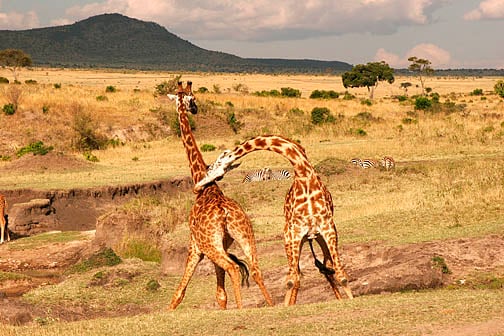
For centuries we have asked questions of evolution. Questions such as why does a Leopard have spots, how did a Camel get it’s hump or perhaps most famous of all: why is a Giraffe’s neck so long? A lot of the time people create “just-so” stories to answer these questions. For example, “it was favourable in terms of evolution by natural selection to be a Giraffe with a longer neck to reach higher branches”. When this theory was tested they found that Giraffes actually spend most their time foraging in low branches. Scientists now believe the long necks are used by males to fight each other for access to females to mate with. (The fact they can also reach higher into fruit bearing trees is an added bonus!) This is called necking. There are plenty of videos on YouTube if you are interested! Most just so stories have now been tested and more scientifically minded and testable hypotheses have been given to describe them. However there is one story that has been puzzling scientists until now: why does a Zebra have its stripes?

http://alumnus.caltech.edu/~kantner/zebras/pictures/ZEBRAS.JPGThis debate has been going on for around 120 years and provides the first real clues as to why Zebras have such bold patterning. Over this period of time many proposals have been made, including confusing predators, camouflage amongst the grasslands and individual identification amongst a herd. None of these proposals had been tested and there were obvious teething problems to begin with, such as a black and white camouflage for a green and yellow (sandy) background.

However, research indicated that some disease transmitting pests have a preference for black squares rather than black stripes, white squares or white stripes. A team of researchers from the University of Sweden found that horseflies preferred dark coloured horses to lighter coloured, and attributed this to the sensory systems used to detect these animals. Using some plastic horses, vegetable oil and various black and white patterns these Swedish scientists seem to have cracked the story! The team found that the stripes of a Zebra are very unattractive to the disease spreading pests. The reason seems to be because the black and white stripes give off a non-uniform light pattern, compared to the uniform light given off my black squares.

While there are many other factors that may be responsible for repelling these pesky insects, this theory certainly seems plausible. If the selection pressure of disease carrying insects is enough to drive such strong patterning is yet to be discussed. To me it does seem a little far-fetched but the experimental evidence is there to suggest this is correct. If the Zebra’s black and white stripes are a result of the insects this study suggests then it wouldn’t be the most wild and unbelievable feature natural selection has thrown up!

Further reading:
Just so stories by Kipling – (Fun book on Amazon for a penny! – http://tinyurl.com/77yuddl)
More info on the Giraffe just so story – http://www.how-come.net/giraffeneck.html
The original paper – Egri, Á., Blahó, M., Kriska, G., Farkas, R., Gyurkovszky, M., Åkesson, S. and Horváth, G. (2012). Polarotactic tabanids find striped patterns with brightness and/or polarization modulation least attractive: an advantage of zebra stripes. J. Exp. Biol. 215, 736–745. (Limited access).

Print Friendly

Posted in Uncategorized | Leave a comment

Mosquitos – To kill or not to kill, that is the question.

The climate we live in today is one of change. There is a huge debate as to if that change is for the better or worse, but the fact remains the climate is changing. This is not a new phenomenon. The climate has radically changed since the beginning of life some 3.6-3.8 billion years ago. However, no single species has ever been directly responsible for changing the climate – until Homo sapiens rocked up. We are changing the climate so quickly evolution can’t keep up. This means many species are struggling to survive, leading to a significant number of species extinctions. We are very quick to jump to the needs of endangered species, particularly those that are beneficial to us. But what about the species we don’t like? What about mosquitos? How many times have you been on holiday and got a nasty bite, or been forced to religiously take anti-malaria tablets? Mosquitos are irritating disease spreaders, so why don’t we just get rid of them?

When a species is under threat of extinction the typical conservation biologist’s argument is that the species must be conserved because of the impact its removal would have on the ecosystem. But what would happen if we made mosquitos extinct? Mosquitos as we know them have been around for roughly 95 million years. As a result they have well defined interactions with many species. Without mosquitos, some predators would not have prey and some plants would not be pollinated. As with all matters of conservation, the value of the species must be quantified. But the value of mosquitos is highly variable, dependent on the species in question. Often the value of the species to humans is considered most important. Mosquitos have little, if any benefit to humans, direct or otherwise. Furthermore, the theory of evolution would suggest, any niches currently occupied by mosquitos would soon be taken up by other insects.

Findings published this week in “The Lancet” suggest malaria killed a staggering 1.2 million people in 2010. This result emphasises the urgent need for mosquito control and perhaps extinction. The concept of mosquito eradication is not a new one. Many attempts have been made around the world, most famously being the use of DDT in America in the 1940s. In 2010, worldwide malaria control cost around US$1.88 billion for insecticides and $2.09 billion for nets, again emphasising the need for mosquito control. With advancing technologies alternative controls are beginning to be developed and tested. These include RNA interference, male sterilisation and improved chemicals.

Returning to the concept of a world without mosquitos, the result would be a huge reduction in the number of people dying of mosquito-transmitted diseases. This would mean even greater human populations in malaria stricken regions. While many of these countries can barely cope with the social and economic costs of their current population sizes, these costs are unlikely to outweigh the benefits of a larger but healthier population. It seems there is a touch of irony that we are more than capable of threatening the extinction of a species beneficial to us, such as tuna, but we are unable to impact mosquito populations, which come at such a devastating cost to human life.

Print Friendly

Posted in Uncategorized | 3 Comments

Parental Care and why daddy wasn’t there.

The theory

In humans, children tend to be brought up by their mother and father, but in the rest of the animal kingdom that is not always the case. In some animals, only the female looks after the offspring and in other cases only the male. But why does this happen? What advantage does a parent have in leaving their offspring in the care of another? Why not stay and protect your young?

More often than not parental care is maternal. Why? The common explanation is that the female has already invested so much into the offspring that it is worthwhile to ensure the survival of their offspring. This investment includes the production of large gametes and the period of gestation. But this hypothesis conflicts with the Concorde fallacy. The Concorde fallacy suggests only future costs are relevant to an investment decision.

Another common argument is that anisogamy (the union of gametes of a different size) produces a male based operational sex ratio (OSR). This means there are more males than females and as a result, males have to compete for females to mate with. If males are competing, paternal care is less likely to evolve as it would take up resources that could instead be used to compete. However, this argument falls flat considering under the Fisher condition whichever sex faces the most competition should exhibit the most parental care. So why isn’t daddy there? No argument has yet been proved, and it is still a conundrum for evolutionary biologists.

The exceptions

As is often the case in biology there are exceptions to this rule, when it is the father that looks after the offspring. So why is daddy there? There are many examples of paternal care in fish. Male fish still produce vast quantities of sperm, and could still have many more offspring if they skipped out their parental care responsibilities, so why waste time and resources caring for their young?

Sticklebacks are known for their paternal-only care. They guard a nest with a clutch of fertilised eggs and protect them from predators. These males are also attractive to females and often females lay their eggs in a male’s nest. The male fertilises the eggs and will protect them with his other clutches. A male can brood up to 10 clutches of eggs during the 2 week gestation period whereas a female could only brood 7 clutches (and would not have time to defend her young or forage for food for her).

Conclusions

It is obvious the case of parental, particularly paternal care, is not clear cut. The care exhibited by parents seems to be based on the circumstances (ecological and evolutionary) of the species in question. The evolution of parental care is also coupled to the mating system used by the species (not covered here). It is apparent parental care is a complex issue to understand. It is difficult to uncover the “real” ultimate causes of the behaviour in question, but parental care is unlikely to be fully understood until these causes are defined.

Print Friendly

Posted in Uncategorized | Leave a comment

Lost Animals from 505 million years ago – A fun Christmas read!

Lost Animals from 505 million years ago

It’s Christmas Eve and I can’t bring myself to write a serious post so instead I am bringing to you a feature on some of my favourite animals from the Cambrian – a period of time 542 million years ago.

Anomalocaris

Anomalocaris

  • Anomalocaris – This is one of my favourite animals from the Cambrian era. It was a top predator that swam by undulating the flaps at the side of its body. The most prominent part of Anomalocaris is in my opinion the two tusks extending up to 7 inches from the head.  By examining holes in the fossils of potential prey items, scientists think these appendages were used to prise open Trilobites – a shelled animal, a bit like a crab (see below).


Trilobite

Trilobite

  • Trilobite – This is the prey of Anomalocaris (above). The Trilobites were incredibly diverse and came in 000’s of shapes and sizes (17,000 known species)!  They had many different ways of living from scavengers to predators and even forming symbiotic relationships with bacteria! Because of their amazing exoskeletons Trilobite fossils are incredibly sort after items fetching several thousands of pounds at auction.


Hallucigenia

Hallucigenia


  • Hallucigenia – this thing is just plain weird! A worm-like tube that walked on stilts! Specialists in the field were perplexed for a long time about the strange animal and even used to think it was the other way up! It has no resemblance to anything alive today, particularly because of the spines protruding from its back. We still don’t know for sure what these spines were made of, and their protection value – if any!


Opabinia

Opabinia

  • Opabinia – Like Anomalocaris, Opabinia had flabs on the side of its body that allowed it to control its movement. Unlike Anomalocaris, Opabinia has a proboscis (like an elephants trunk) which it probably used to pick up its food (like an elephant). Opabinia also had 5 eyes, and presumably a huge field of vision for locating prey (small soft-bodied creatures – not Trilobites or Hallucigenia) and predators (such as Anomalocaris).

There is no doubt that these animals are weird and fantastic for that weirdness. They represent a few of the many oddities natural selection can throw up. The fact that there are not 5 eyed predators or worms on stilts today, suggest these animals were evolutionary experiments, no longer suitable for the conditions we live in today. Or is it? We still know very little about the animals that live in the depth of the oceans. Could there be animals down there that resemble the animals that lived 550 million years ago?

For a better idea of what life was like as an animal 550 million years ago please watch the following short videos at:

http://www.lightproductionsvideo.com/Cambrian-Animals.html

Fantastic animations!

Merry Christmas and a Happy New Year!!

Print Friendly

Posted in Uncategorized | 1 Comment

Orangutan real-estate provides new hope.

Spending time with a particular animal undoubtedly creates a bond that stays with you for a long time, if not for life. In my life, this has been the case for my horses, dogs, the elephants I looked after at the zoo, as well as a certain cheeky tapir that liked to have his tummy tickled. Another animal I became particularly attached to was the Orangutan.

During my time in 6th form I was lucky enough to get the opportunity to go and stay in Borneo for 2 weeks. I have so many memories from those 2 weeks, and am relieved I kept a diary of all my activities and emotions while I was there. At the time I was 16 and even at that age what I saw on the flight into Brunei stamped an impression on me I will never forget. Flying over the coastline, the ocean was not the brilliant blue you would expect, but a dark, mucky brown colour flooding straight from the island’s rivers into the sea. Once past the coastline we began to fly inland. I do not think it is possible for me to describe to you how vast the palm oil plantations on that island are. They stretch on, mile after mile after mile. I thought I knew how bad the deforestation was out there, but I was mistaken on an unimaginable scale.

During our time in the rainforest we were privileged to witness wild Orangutans, separated from us only by a couple of metres of water. I could have sat and watched them for every hour of every day I was on that island. Funnily enough, we even met some people who do just that. In an effort to learn more about their behaviour there are people who silently follow several wild Orangutans and note down everything from what and how much they eat, to how many times they excrete.

While we were there we also helped plant part of a new rainforest corridor linking two parts of undamaged rainforest. The purpose of which was to give Orangutans more space, and by connecting different territories, there would be more chance of mating and therefore greater gene flow between the populations. This helps the Orangutans in the wild but what about the ones rescued and rehabilitated? An adult male Orangutan is capable of ripping a human in half. As such it is neither practical nor fair to keep these animals in captivity if it can be avoided.

A novel idea proposed by the Australian Orangutan Project and an eco-tourism company are partnering up with an Orangutan conservation group in Indonesia. They are trying to raise money to buy land in Sumatra to create land isolated by moats to protect these animals while keeping them in their natural environment. The rehabilitated Orangutans can then be observed and monitored to ensure they are safe and healthy

The project organisers are hoping to raise 80,000 Australian dollars to lease 3 hectares of land for the Orangutans as well as an education centre. The education centre would try to teach the locals how they can live with the Orangutans still in the wild without conflict.

I know this proposal isn’t exactly ideal. In an ideal world the Orangutans would be able to roam free and safe in their natural habitat. But that isn’t the case and I can’t see it becoming the case any time soon. It would seem to me the damage done is too great. So we have to look at what can be done. The idea of a half-way house seems to me to be making the best of a bad situation. I would be devastated if things get so bad the only Orangutans were found in captivity, and this is certainly a step in the right direction.

http://green.blogs.nytimes.com/2011/11/25/retirement-islands-for-orangutans/?smid=tw-nytimesscience&seid=auto


Print Friendly

Posted in Uncategorized | 1 Comment